Dunham Hall Theater is soon to transform into a dark, mysterious place as the beloved classic “Into the Woods” enchants audiences with its fast-paced, witty lyrics and charming, ever-evolving characters.
Director Peter Cocuzza said every other year the theater department does a joint production with the music department.
“It’s a way for, not only us to involve our students in a musical, [but also] for the music department to promote its new area, so it’s kind of a win-win-win,” Cocuzza said. “The other side of it is we always try to be eclectic with the selections for our season and one of the things we should do at some point during a student’s tenure here, is to do a musical. So taking all that together, this show was chosen in part for the people for who we believed would be here so that we could [best] cast it out of the casting pool.”
Despite being a musical, Cocuzza said the distinctive music in the production is what makes it stands out from other shows.
“The music — since it’s a Stephen Sondheim written piece — the music is intricate, difficult and quite appealing to a music person, yet at the same time the ‘theatericalness’ and the fairy tale story is appealing to the theater person,” Cocuzza said. “The combination and the success of the piece since its inception is just historic, so it seemed like the appropriate and challenging choice.”
Page Design by Caitlin Grove
Cocuzza said the concept for this particular production is nothing out of the ordinary.
“It’s just staying with the traditional storyline; we’re not updating it. We’re just trying to embellish what the playwright wanted to say in the story,” Cocuzza said. “There was a message — we’re trying to get in part the message across.”
Cocuzza said as for the set, things will come on and off stage throughout the show, as opposed to a full transformation.
“This particular set is a unit set, meaning it’s one set that doesn’t move a lot, but there are pieces of it that will move and minimal pieces that will come on and off,” Cocuzza said. “It’s not like the whole set somehow just changes completely, but there are additions and things happen, so it’s embellished.”
Cocuzza said creating not only a set of this sort, but the production as a whole would be hard if one had never done it before.
“It’s like anything else; if you’ve never hit a baseball it would be hard, but if you’ve practiced for years, then it’s just refining your game. Same thing here — it can be an interesting, challenging process, but it’s not one that is [too hard]; the team can overcome,” Cocuzza said. “The team is also [comprised of] experienced professionals. When I say to the scene designer, ‘How are we going to do that?’ and he’ll go, ‘Oh, I have an idea.’ So you trust that this is all a team effort.”
Cocuzza said one of the most challenging parts of the production process was casting roles.
“If you cast it well, your job is done. Then you can rely on the talent of the actors and musicians to do their part,” Cocuzza said. “But we are a teaching institution; we expect to teach, we expect to be having moments when its really a rehearsal, but there’s also a lesson here.”
According to Cocuzza, the casting process fell into place fairly quick due to the amount of talented students who showed up to auditions.
“As it turned out, half of them are from music, half of them are from theater and several of them are non-majors of either one,” Cocuzza said. “It’s a nice mix of people; we actually have two faculty in the play — so some of the students can see how the faculty are working. It’s a wonderful experience.”
Cocuzza said audiences should be prepared to sit for more than two and a half hours, as they are not cutting anything from the original play.
“It’s such an intricately written play, that if you took out a part of a story, it almost doesn’t make sense if you’re really listening and watching the play,” Cocuzza said. “If you’re just letting the play wash over you, then you won’t really notice, but if you’re really listening there’s a point where you’ll say, ‘Well how come the Baker — where did that come from?’ because somebody took it out. That’s why we didn’t take anything out.”
According to Cocuzza what audiences are going to see is very close to the original Broadway production.
“Anytime they make a movie of a Broadway show, they take liberties with it — in the musical there were added songs. [The audience is] going to hear all of the original songs, all of the original dialogue,” Cocuzza said. “Now understand, since the Broadway opening it has several revivals, where the artistic team who made the original concept made some minor changes, but it’s very close to the original.”
Since the film interpretation of “Into the Woods” was recently released, Cocuzza said it is very different seeing a movie version of a musical and its live stage version.
“Live theater is live theater — you can’t replace it,” Cocuzza said. “If they are willing to embrace it, I really think they’ll enjoy it. It moves fast, the songs are kind of catchy, the fairy tale characters are recognizable, hopefully there are enough special effects and smoke and lights so people won’t be bored.”
Cocuzza said he likes this particular play because it is different than what one would expect from classic fairy tales.
“It’s not the standard book musical — and by that I mean somebody starts, there’s a character, they fall in love, they fall out of love, they get the girl back, the town gets the band — things like that,” Cocuzza said. “But in this story, there’s parallel plots and just when you think you’ve seen enough and everybody has a happy ending, Act 2 starts and we all realize that nobody has a happy ending. That’s kind of part of the message of the play — life is not idealistic. We have trials and tribulations and so do fairy-tale characters, life goes wrong, the prince leaves them, a giant comes down from the sky.”
Cocuzza said if nothing else, he hopes audiences appreciate how this university tries to provide its students with a number of opportunities to do a variety of endeavors.
“There’s athletics, there’s clubs and there’s marketing and science events — and then there’s theater events,” Cocuzza said. “The student here who’s really looking to have a fulfilling college experience should try to experience all of those things. The experience in the theater is going to be different than the experience at a soccer game or some other kind of event. It’s enjoyable, it’s a date night — for some people it’s required. The fact that arts should be part of our lives in some way shape or form, I think our lives would be drier and duller if we didn’t have them.”
The Granny, the Giant, makeup and mask designer
Junior theatrical design and technology major Shawna Trusty, of Excelsior Springs, Mo., said she has been a huge fan of “Into the Woods” since she was a little girl.
“I’ve seen it about four times live,” Trusty said. “I think [I like] the idea of happily ever after and then life isn’t like that and this is one of those shows that show what happens after the ever after.”
Trusty said during the casting process she was open to any of the available roles.
“[Cocuzza] knows I’m really into vocal stuff,” Trusty said. “He said he was considering me for the Granny and the voice of the Giant, and I could still do the makeup for the show and I was like, ‘That would be great.’ It would give me the opportunity to have enough time off stage so I could do the design work as well.”
Trusty said the character of the Granny is much more entertaining than one would think.
“She’s just playing on the borderline of senile versus her wisdom,” Trusty said. “She’s a crazy old lady, but she’s pretty nimble for her age. [Cocuzza] has me leaping over tree trunks and jumping over stuff. She’s kind of nutzo — skinning wolves, kind of [an] outdoorsy crazy grandma — but she’s really smart, like the things she says in the interludes are really good words of advice — ‘The greatest prize can often lie at the end of the thorniest path.’ It’s kind of weird wisdom [going along] with this kooky character.”
Trusty said she had an exciting time developing the character of the Giant.
“When I first think giant I thought, ‘I am a giaaaannt,’ big, over the top verbalization and [Cocuzza] said, ‘Lets try to find a backstory for her.’ I decided I don’t think of myself as a giant; I am a woman and you guys are just really small,” Trusty said. “She’s like a suburban house mom; I picture her as the woman with the angled haircut who’s like, ‘I will wait right here until I see your manager.’ So she’s looking for answers, wants it done and she gets really angry.”
Trusty said for the makeup side of the production, the witch’s transformation is the biggest challenge she faced in this production.
“[The actress] has to do the transformation herself on stage, so I’m making two sets of masks. One is an actual prosthetic that will be attached to her face; another one is an old woman mask that was already made that I’m painting to look more like what her makeup will look like, so she can just take the mask off and her good makeup will be underneath,” Trusty said. “We did a live fast cast of our actress, which had her lying back in a chair forever, putting plaster all over her face. From that I build up a sculpture out of clay, so I’ve built up cheeks and a huge prosthetic nose.”
Trusty said she loves the fact that this production is not afraid to hold back.
“Costume and set wise — it’s kind of over-the-top; even all of the female makeup I get to be doing is kind of fun,” Trusty said. “The stepsisters, they say they are pretty of face but we talked about making them some more gaudy makeup because they don’t know what they’re doing, so I get to make them kind of ugly pretty. A lot more of it has been age work.”
Trusty said she enjoyed how this production provided perfect collaboration for the departments.
“With a musical for SIUE, it’s a huge time for the music and the theater departments to come together, because we live in the same building but we don’t intermingle as much as people would think,” Trusty said. “So the collaboration between the music department and theater department, and also collaborating with the scene designer and costume designer, as well as the actors to kind of make this process come to life has been the best thing.”
Cinderella
Senior vocal performance major Sarah Paitz, of Maryville, said her character’s story begins like typical Cinderella, but evolves throughout the production.
“The first act is where [Cinderella] gets her wish from her mother and she gets to go to the ball. Basically, the first act … is her being [indecisive] of if she wants really wants the prince, because the prince is after her, or if she should just go back to her life she’s always known,” Paitz said. “Then at the end of the first act, she finally gets her prince, she lets him make the decision, not herself. In the second act its more evolving of she finally gets to make her decision and decides what she wants, which changes a big part of her life.”
Paitz said she has loved this play forever. Ever since she started musical theater Cinderella has been one of her dream roles.
“Personally I believe I relate to Cinderella a lot,” Paitz said. “I never know exactly, even now I don’t know what I want in life and I feel like I can portray her in a way that’s very personal to me.”
Paitz said the musical aspect of the production stands out for her.
“I think my favorite song is between the princes — ‘Agony.’ It’s so funny and they do it very well; they play off each other extremely well,” Paitz said. “I think my second favorite is ‘No One is Alone.’ I sing that with the Baker, Little Red [Riding Hood] and Jack and I feel like it’s a revelation between Cinderella and the Baker. We realize that life happens, but no matter what someone is always going to be there for you through thick and thin and I think they finally realize that — that they’ve never been alone.”
Paitz said she is very impressed with how the set is shaping up.
“I think the set is absolutely amazing,” Paitz said. “[Roger Speidel] always does a phenomenal job. I think the cool part is we actually have Rapunzel’s tower coming out of the floor.”
Paitz said Cinderella’s costume for the production would make anyone feel the transformation ‘from rags to riches.’
“I have the typical rags she always wears and her big ball gown that we are actually doubling as a ball gown and a wedding dress because it’s white — so we are just kind of going to glitz it up a bit for the wedding with a veil and stuff,” Paitz said. “I tried on the rags the other day and I really felt like I was a person who was not appreciated and I felt it more when I actually put on the costume. I think that happens to everybody — when you actually put on the costume it’s more real to us.”
Paitz said she has been dreaming of this role for a long time.
“I feel like if kids come see this I want to also be a role model for them and show them it’s not a typical Disney princess. [She’s] also someone who can think for herself and make her own decisions. You have control of your own life and you should go for what you want and not what everyone else thinks you should have,” Paitz said.
Paitz said she cannot wait to see how this production comes together.
“It’s an amazing group of people; everyone was casted very well [and] we all get along really well,” Paitz said. “It’s such an amazing process to go through and I think it’s going to be one of the greatest shows yet.”
The Narrator
Junior theater performance major Ben Nickols, of Excelsior Springs, Mo., said “Into the Woods” was the first musical he performed in back in middle school.
“I’ve always had a spot in my heart for this show,” Nickols said. “So as soon as I found out we were doing it, I was crazy; I was like, ‘I want to be in this show.’”
Nickols said it was quite the challenge to create his character, as he did not have much to go on.
“The Narrator is really hard because he is kind of an outside force — versus everyone else. He doesn’t interact with [the cast], so it’s really hard coming up with a character instead of just being this person telling these lines,” Nickols said. “I decided I had to create my own backstory — I had to give myself a name and all this [to] give it more dimension. When I talk to the audience, I talk to it like I’m telling the story to my child — it makes it more personal and gives more of a connection. I get really excited about it. In parts I’ve kind of made it seem like I’m making up the story as I go, which kind of brings this other depth to it.”
Nickols said there are a lot of differences from the movie and the musical, specifically with his character.
“My character is completely cut out from the movie,” Nickols said. “The song ‘Your Fault,’ when they are blaming each other, has a much more emotional impact on stage than [in] the film. There is more of a rush — the tempo of the song is brought up really high. It’s probably my favorite part of the show. There is a moment that they cut from the play when the Baker’s Wife and the Baker go separate ways; there is actually a fight scene there, which actually gives much more dimension to the Baker and his anger coming out toward the group during that song.”
The Baker
Freshman musical theater major Miles Tillman, of O’Fallon, said the Baker is a typical guy, struggling to find his way and provide for his family.
“My character is really just a guy who the entire time is just overwhelmed — he’s just frazzled through the entire play because he just found out there is a curse,” Tillman said. “He’s also very dependent on his wife, even if he won’t admit it. He’s like the average man who wants to have a child and will do whatever it takes to get that done.”
Tillman said the role of the Baker is completely unlike roles he usually plays.
“I’ve always played cool guys, so when I got this kind of dad figure, it was a different kind of role,” Tillman said. “It was weird because I’ve never played anybody like this, so it was hard to adjust to the new kind of role. I wasn’t expecting it, but I’m grateful that I got it.”
Tillman said even though this was not the role he expected, he appreciates it now.
“I sing ‘No More;’ that’s a ballad near the end of the second act — I love that song,” Tillman said. “It’s a very emotionally tying song both for me and the audience I feel. He’s in the center of this fairy tale and it’s amazing — I really can’t pick one certain [favorite part of my character].”
Tillman said one of the most challenging parts of this process was the amount of lines he had to memorize.
“It is a three-hour play, so when you’re the lead in that, there’s a lot of stuff,” Tillman said. “I was definitely overwhelmed when I saw the amount I had to get done.”
Tillman said the entire cast went through a lot to really make their characters their own; however, he had a unique approach to his process.
“I haven’t seen the production and I did that because I didn’t want my performance to be based off of how somebody else did theirs” Tillman said. “You could say that’s going in blind, but I think it’s going in fresh and you can make the entire thing.”
Tillman said the set design is impressive on many different levels.
“The scene shop is really making our stage [so] you feel like you really are in the center of it,” Tillman said. “The woods come out and suck you in and you feel like you are in the woods. Our scene designer — he’s the guy who plays the Wolf — and he’s taking on a humongous part and he’s amazing.”
Tillman said he could not be more excited for this production.
“The cast is amazing, the direction is amazing and the production is going to be amazing,” Tillman said.
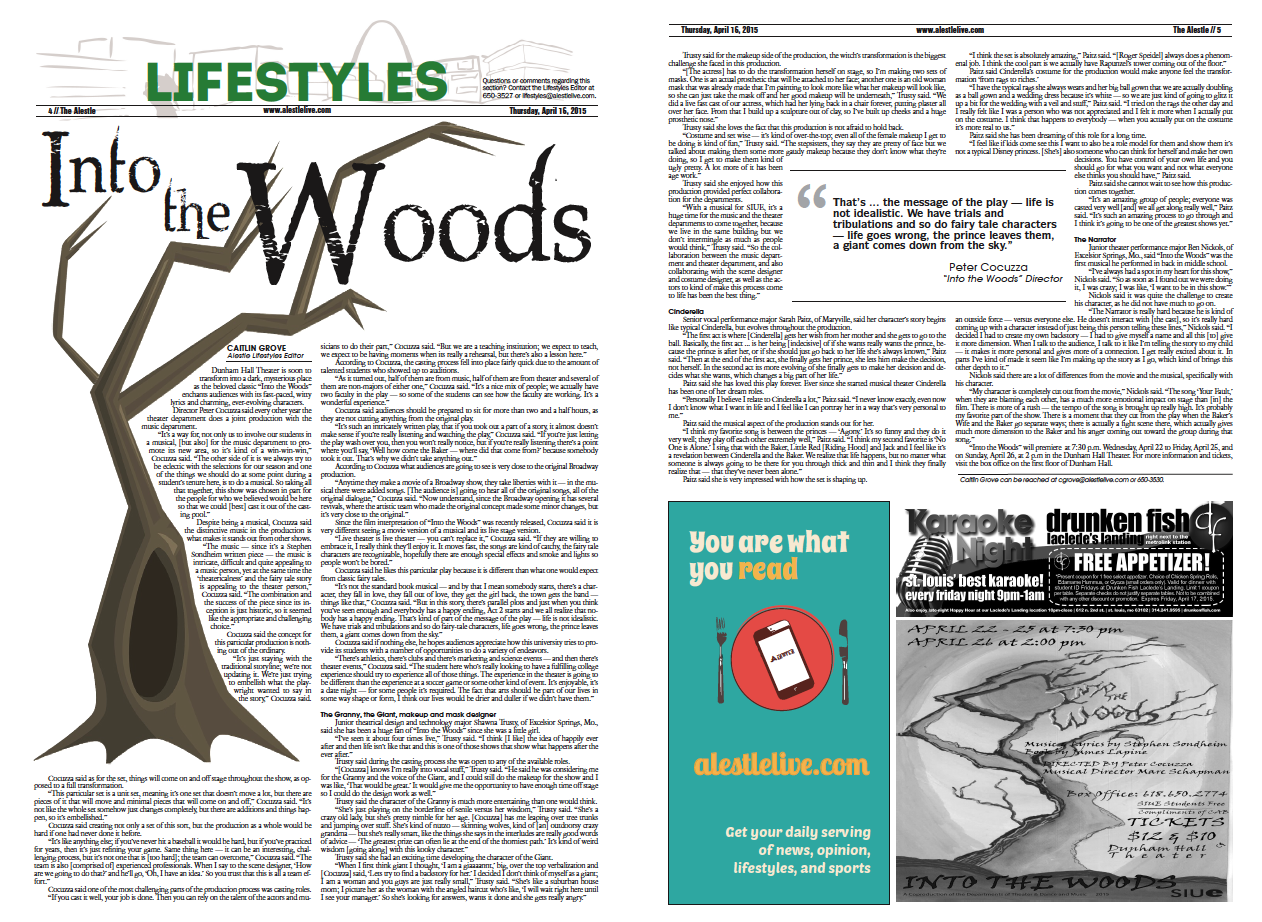
“Into the Woods” will premiere at 7:30 p.m. Wednesday, April 22 to Friday, April 25, and on Sunday, April 26, at 2 p.m in the Dunham Hall Theater. For more information and tickets, visit the box office on the first floor of Dunham Hall.
Article by Caitlin Grove
Via alestlelive.com



 Caitlin On Life