
In this day and age, when one sees beautifully sculpted works of art, he or she tend to assume it was created in generations past. However, St. Louis has an experienced sculptor who has made a significant impact in the art world.
Harry Weber was born in St. Louis in 1942 and has since created well-known sculptures across America — from statues of legendary St. Louis Cardinals players standing outside of Busch Stadium, to an 18-inch maquette of Jack Daniel’s, the famous whisky distiller.
On Wednesday, Feb. 25 and Thursday, Feb. 26, student organization Sculptors at Wagner brought Weber’s creative genius to campus to enlighten students. During his visit, Weber presented students with a lecture regarding his skillset and career, as well as a firsthand demonstration on how he produces his work. Weber also sat in on a figure modeling class and was given the opportunity to directly work with the students.
Weber said, at 72 years old, he has been immersing himself in the world of art his entire life.
“As a kid I had a bad habit of sketching on everything — walls, tablecloths, napkins, anything — and I still do,” Weber said. “I literally cannot remember a day where I haven’t drawn at least one picture, and that [is] still my major entertainment — drawing dogs and horses.”
Page Design by Caitlin Grove
Following his education at Princeton University, Weber served during the Vietnam War, serving in the United States Navy for six years. While in Vietnam, he spent a year on water patrol and developed a series of sketches documenting his time there. These sketches are on permanent display at the USS Alabama Battleship Memorial Park.
During the past 34 years, Weber has created more than 250 notable national art pieces, ranging from busts to larger than life-sized statues. Some of Weber’s most recognizable work includes various sports figures, featured at stadiums including St. Louis’ Busch Stadium, Kansas City’s Kauffman Stadium and Nationals Park in Washington D.C., among others. In 2011, Weber was named National Sports Artist of the Year by the United States Sports Academy.
Weber also has had experience with many historical works of art, including a life-sized sculpture of Dred Scott and Harriet Scott outside St. Louis’ historic Old Courthouse, a life-sized bust of Thomas Jefferson and a twice life-sized statue of Lewis and Clark for their 200 -year anniversary in 2006, standing on the St. Louis Riverfront.
Weber said when it comes to sculpting, he has two distinct favorite parts.
“The part that’s the quick assessment of the subject matter — getting a quick assessment of what you want done early on [is one of my favorite parts],” Weber said. “It’s really the very beginning and the very end; the beginning is when it starts to take shape, and the very end is when you step back and say, ‘I’m finished.’”
Senior art major Mary Peacock, of Carbondale, said she enjoyed delving into the world of Weber’s work through his lecture and demonstration.
“I’ve always been influenced by the human form, but at the same time [Weber] seemed to take it to a new level,” Peacock said. “He was able to create emotion upon the sculptures themselves. I know I’ve seen a lot of sculptures where you see it and you’ve felt something, but you really get the emotion from his work.”
Weber said as a sculptor, the majority of what he creates is commissioned work, so the subject matter is provided to him. However, the presentation of the subject matter is still very much up to him.
“I start with a lot of concept sketches because a sculpture has to exist in three-dimensional space, not two-dimensional space, so it has to work all the way around,” Weber said. “So before you start, you have to make sure that when people walk around that piece, they are going to have something good to look at all the way around. The other piece of thought in the concept [is] even though I deal pretty much in realism, I consider artwork — particularly three-dimensional artwork — to be so valuable that it should work as an abstraction, even if I’m showing a human form. I like to have the movement be harmonious with what’s going on around [it] — it should be striking as a form in and of itself and not just as a recognizable person.”
Peacock said one of the main things that influenced her was when Weber showed his sketchbooks during his lecture.
“It made me want to go back and look at my older work,” Peacock said. “When I was younger, I did a lot of sketching — I was a cartoonist. I really wanted to inspire that, but it also made me think about how I look at people. In his sketchbooks he said, ‘Go to a bar, sketch somebody out,’ but he would actually have conversations and get to know the person, or even make a conversation up in your head by the way they looked and the way they formed their faces.”
Weber said when it comes to his sculptures and projects, he has many favorites, depending on the topic. However, there is one in particular that stands out in his mind.
“Bobby Orr up in Boston, [was a favorite] because it was so fast,” Weber said. “Normally a life-sized sculpture will take anywhere between nine months and a year to finish — they gave us five and a half months from concept to instillation. It was a lot of work and it turned out great.”
Senior sculpture major of Nokomis, Sophia Ruppert, president of Sculptors at Wagner, said when the art department hosts a visiting artist, they will have both a lecture and a demonstration in order to provide a greater impact on students.
“We like to have the lecture first, that way we get a sense of how the artist works, where they are pulling their ideas from and whatever experience they are going to bring in. It’s a great way to get to know the artist and to know what they are going to be talking about at the demonstration,” Ruppert said. “The demonstration is hands-on; they show a new technique.”
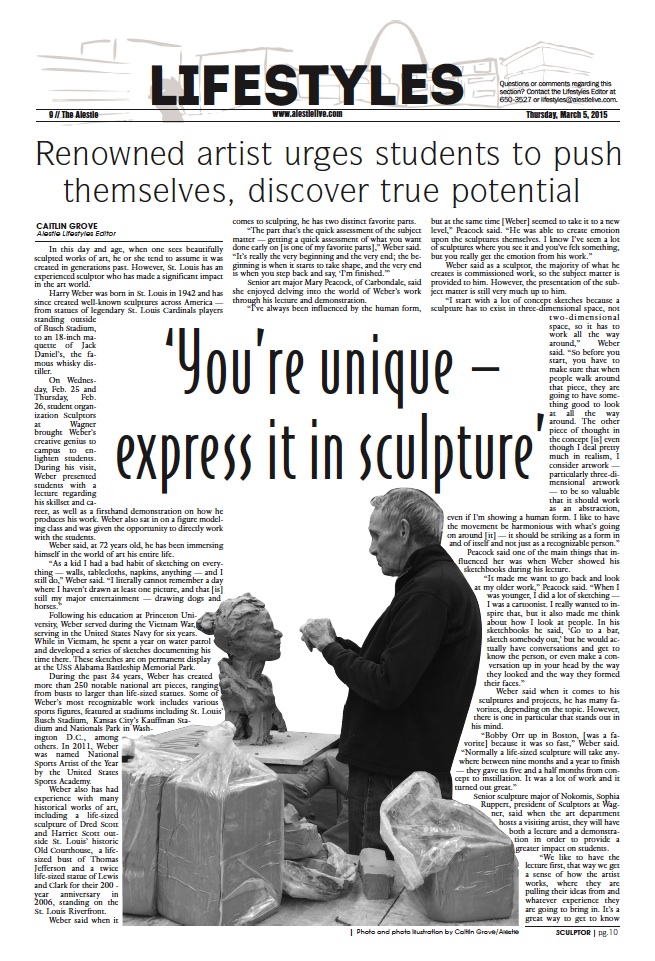
Weber began his demonstration by sculpting Ruppert, who was sitting in a chair in front of him. He was given only a pole to use as the backbone of the bust and clay to produce a work of art. He first began by forming the head and within a few minutes, one could begin to see distinction of the back of the head and chin — nothing close to facial features, but shape could be seen.
Once this was established, he then used a wooden dowel to support the shoulders. After this was in place and the shoulders were set, Weber began to focus on facial features — forming the eyes and forehead first, then moving onto the chin, nose and mouth. A mere 45 minutes after he started, Weber had not only the form, but a good majority of the facial features in place.
Weber said the traditional process of creating one of these sculptures takes quite a bit of skill and patience.
“First step is the sketches. Then almost every sculptor works with a maquette, which is a fancy French word for small model. Since we’re pretentious people, we still call them maquettes and not small models,” Weber said. “So we make a small model, about two feet high. Up until about 15 years ago, we would solve all of the problems — three dimensions and movements — in something that was malleable, we could make sure the 360 degree thing [worked]. Then what we used to do was make a rebar skeleton in whatever size we wanted to make it, pack it with foam and then pack it with clay and sculpt it back. That took two months at least just to set the foam.”
However, Weber said the technological advances of recent years have substantially sped up the process.
“Nowadays, we take that model, we scan it with a laser [and] we take the digital information that comes out,” Weber said. “We then take it, put it in the [computer numerical control] machine and cut out blocks of foam that can be assembled into the statue as big as we want, then pack that with clay and the sculpting takes over. It’s expensive, but it saves easily two months.”
Ruppert said the art department has not brought in a figurative artist in some time, and since many art department students are interested in sculpting, they felt it was time. Ruppert said demonstrations of this sort are beneficial to students in expanding their horizons.
“Our professor has one way of modeling the figure and [Weber is] bringing in a new technique,” Ruppert said. “The diversity of education is helpful because [Weber’s] technique might work better for some students; everyone has a different style and it’s really great to learn new ways to do things. It could really revolutionize the way people work, depending on their previous experience.”
A little under two hours later, Weber had completed the portrait bust of Ruppert and she was very pleased with the results.
“I think it’s real fun; I’ve never posed before,” Ruppert said. “I tried not to look as rigid, because like he talked about the flow and the energy of the human body — I tried just to sit and watch the demo. I’m kind of geeking out about it. I don’t work a lot with clay but it’s really fascinating to see him do it. He works really fast and it’s amazing to see what he got done in such a short amount of time.”
Peacock was moved by Weber’s take on balancing his career as an artist and family.
“His spouse is very important to him. She’s the one who stops him from going too far, and since I have a husband myself, and two young sons, it was definitely inspiring,” Peacock said. “Not many artists will say that — they are very anti-family; they think you’re not going to be successful, and he really broke the mold by having a family and doing this.”
Weber said he hopes students take away the idea that like any other endeavor in life, art takes skill, patience and perseverance.
“Talent is one thing; talent and circumstance is luck of the draw — you were either born that way and where you were born depends on what you can get,” Weber said. “I hope they come away with the idea that it takes a fair amount of time to get skillful enough to create with facility and it just takes that much practice. Also, to give them the confidence that you don’t have to pick away at a piece of artwork; you can move through it. It’s like [how] a tennis player can’t think about the dynamics of a backhand; as an artist you can’t think about making a mark on a piece of paper. You’ve got to let the connection between your brain, your eye and your hand be absolute.”
Ruppert said she learned a great amount about sculpting from Weber’s visit.
“[I’ve learned] to trust your eyes more than you trust your brain,” Ruppert said. “Whenever you do portrait stuff, you think, ‘I’m gong to draw this eye’ but it’s really the whole form and the eyes are connected to the understructure and everything connects together. It’s really been an exercise with the eyes more than the brain; I think that’s what I’ve learned the most — just looking at things rather than trusting your previous knowledge about it.”
Peacock said she enjoyed hearing about Weber’s knowledge of history and overall enthusiasm for this lifestyle.
“His experience in life — he really embraced life in general,” Peacock said. “Maybe it was his background in Vietnam that inspired him to really seek life, but he seemed to really grip it by the horns and [have the attitude of], ‘If you really want something, you go for it.’ He really infused that his wife helped him out and backed him up completely, and I thought that was really cool. He was a really sweet man and he really is approachable and friendly and his enthusiasm is just amazing.”
Layout design/ article by Caitlin Grove
Via alestlelive.com



 Caitlin On Life